The movie kicks off in the 1990s Philippines, nailing the exact vibe of our childhoods—the colors, the music, and that specific warmth of long summer nights. We follow two childhood best friends: Jo (voiced by the incredible H.E.R.) and Raissa (voiced by Liza Soberano). Raissa is about to leave the country to study at Caltech in America.
For anyone who grew up in the Philippines, this hits extremely close to home. We all know the painful reality of the paalam (goodbye)—whether it’s a friend, a cousin, or a parent leaving for the States or working abroad. The film captures that heavy, pre-departure anxiety perfectly.
Welcome to Nakali: Where Memories Fade
On their last night together, Jo and Raissa stumble through a portal and find themselves trapped on Nakali, a surreal, supernatural island where their memories slowly begin to fade. The catch? The only way to escape this mystical world is to sacrifice all memories of each other.
The stakes are beautifully high, and the world-building is where the animation truly shines. DreamWorks adopts a trippy, stylized aesthetic that feels like a cross between Puss in Boots: The Last Wish and a vibrant, neon 90s comic book.
What I Loved:
Flawless Voice Acting: Liza Soberano and H.E.R. have incredible emotional chemistry. Dolly de Leon as the grandmother is a scene-stealer.
The Folklore Representation: Seeing creatures like the weredog Raww (Dave Franco) and a genuinely terrifying Manananggal (voiced by Lea Salonga!) felt like our childhood bedtime stories brought to life.
What Missed the Mark:
Convoluted Mythology: The rules of Nakali get a bit tangled and rushed in the second act.
Predictable Climax: The final resolution follows a fairly standard, safe Hollywood animated structure.
A True Culturally Grounded Experience
What makes Forgotten Island stand out from typical Hollywood representation is how natural the cultural elements feel. It doesn’t pause to give the audience an awkward Wikipedia explanation of a Manananggal or why the characters act the way they do. Instead, it trusts the audience.
Lea Salonga’s character as the villain gives absolute chills—it’s brilliant, scary, and a completely fresh take on a classic mythological figure. Yet, despite how hyper-local the folklore is, the core theme of fearing abandonment and wrestling with the grief of growing apart is entirely universal
The Verdict: Bring the Tissues
Forgotten Island is easily one of the best animated films of the year. It is funny, chaotic, and deeply respectful of its roots. By the time the third act rolled around, the theater was filled with audible sniffling. It forces you to look at your own past, the friends you’ve left behind, and the memories that shape who you are.
Whether you’re Filipino or just someone who loves a deeply emotional, visually spectacular story, do not miss this on the big screen.
🎬 Movie: Forgotten Island (2026) ⭐ Rating: 4.5 / 5 Stars 🎨 Studio: DreamWorks Animation 🎤 Star Power: H.E.R., Liza Soberano, Dolly de Leon, Lea Salonga
There is standard tennis drama, and then there is what just happened at Flushing Meadows.
When Elena Rybakina defeated Qinwen Zheng in a grueling three-set semifinal comeback, she officially snatched the WTA World No. 1 ranking right out from under Aryna Sabalenka’s sneakers. After a historic 99 consecutive weeks at the absolute peak of women’s tennis, Sabalenka has been dethroned.
But the tennis gods have a twisted sense of humor. Before the ink can even dry on the new ranking points, these two powerhouses must stand across the net from one another in the 2026 US Open Final.
This isn’t just a Grand Slam final anymore. This is an immediate, high-stakes battle for psychological dominance. Will Rybakina legitimize her new crown, or will a vengeful Sabalenka destroy her coronation party?
If you love brutal, aggressive, first-strike tennis, this matchup is your holy grail. The WTA Tour rivalry between these two currently stands at 10-7 in favor of Sabalenka. However, when the lights get bright and a trophy is on the line, the script flips: Rybakina leads 4-2 in all tournament finals.
They are tied 1-1 in Grand Slam finals. Sabalenka took the 2023 Australian Open crown, but Rybakina fired back by defeating Sabalenka to win the 2026 Australian Open earlier this year.
Factor
Elena Rybakina
Aryna Sabalenka
Current Live Ranking
World No. 1 👑
World No. 2 📉
US Open History
First-ever US Open Final 🗽
Chasing a historic “Three-Peat” 🏆
Path to Final
Rallied past Zheng Qinwen & Coco Gauff
Dispatched Jessica Pegula in straight sets
Signature Weapon
Ice-cold composure & lethal spot-serving
Unhinged baseline power & emotional fire
Sabalenka’s Quest for the Three-Peat (and Revenge)
Make no mistake: Aryna Sabalenka rules New York. The Belarusian is aiming to become the first woman to win three consecutive US Open titles since Serena Williams pulled off the feat from 2012-2014.
When asked about losing the top spot in the press room, Sabalenka didn’t mince words. While she gracefully called it “the beauty of sport,” she heavily hinted at her underlying motivation: “Maybe I will take it back from her.”
For starter, Sabalenka will rely on the terrifying hard-court baseline depth that completely suffocated Jessica Pegula in the semifinals. She is playing with the fury of a displaced monarch.
Rybakina’s Cold-Blooded Coronation
On the other side of the net is Elena Rybakina, the woman who famously rarely celebrates her biggest victories. True to her calm demeanor, Rybakina played down the historic achievement of becoming Kazakhstan’s first-ever singles World No. 1. “It’s just a number right now,” she said. “My goal is to win the tournaments which I play.”
Rybakina’s journey through the draw has been a masterclass in resilience. After battling standard mid-season injuries, she arrived in New York under the radar, only to systematically dismantle the home crowd’s favorites. Her serve is working like a heat-seeking missile, and if she gets into a rhythm early, Sabalenka’s power will be neutralized by Rybakina’s impeccable clean timing.
The Verdict: Who Wins the 2026 US Open?
This match will be decided by emotional control. Sabalenka has the crowd experience and the court history on Arthur Ashe Stadium. But Rybakina has already broken Sabalenka’s heart in a Major final this year.
If Sabalenka lets the sting of losing the No. 1 spot fuel unforced errors, Rybakina will quietly and efficiently pick her apart. Expect a brutal, three-set heavyweight slugfest.
Prediction: Elena Rybakina wins in 3 sets to solidify her reign as the true Queen of Tennis.
What is your prediction for the final? Will Sabalenka secure the three-peat, or is it Rybakina’s era now? Sound off in the comments below!
When Filipino athletes march onto the international stage, they carry more than just dreams of gold medals—they carry the heart and heritage of an entire nation. For the upcoming 20th Asian Games in Aichi-Nagoya, Japan, world-renowned fashion designer Francis Libiran has once again captured that collective spirit.
Officially unveiled during a grand send-off ceremony at the Rizal Memorial Coliseum, the “Malaya” Barong stands as the official opening ceremony uniform for Team Philippines. Following his highly acclaimed “Sinag” Barong for the Paris Olympics, Libiran’s newest masterpiece blends pre-colonial history with bold, contemporary athletic style.
Here is a closer look at the stunning cultural design behind the Francis Libiran Asian Games uniform and how it celebrates the modern Filipino athlete.
(Photo: courtesy of Francis Libiran)
The Meaning Behind the “Malaya” Barong
The word Malaya translates to “free” in Filipino. According to Libiran, the outfit serves as a powerful symbol of identity, freedom, and strength.
“When our athletes step onto the world stage, they carry more than our flag,” Libiran shared. “They carry hope, strength, and love for country. Our athletes carry more than dreams. Dala nila ang puso ng bayan, and it is my honor to dress that courage.”
4 Unique Design Features of the Team Philippines Uniform
Libiran’s latest work pivots toward an artistic, asymmetrical design language that sets it apart from traditional formal wear.
1. Striking Asymmetrical Flag Aesthetics
The foundation of the uniform is a lightweight, unisex body crafted from premium, breathable piña-jusi fabric. Breaking tradition, the shirt features a bold, asymmetrical sleeve in vibrant shades of blue and red. This guarantees that the Philippine flag is immediately recognizable on international television broadcasts.
2. Ancient Baybayin Script and Kalinga Motifs
Look closely at the heart of the design, and you will find deep indigenous roots.
Baybayin Writing: The word “Malaya” is explicitly embroidered into the fabric using the pre-colonial Philippine script.
Kalinga Tattoo Patterns: The yellow embroidery tracing the cuffs and shoulders is inspired by ancient Cordillera tattoo motifs, symbolizing protection, guidance, unity, and faith.
3. The Eco-Friendly “Malaya Cap”
To complete the look, athletes will don a matching Malaya Cap. Keeping up with modern green fashion, it is woven from sustainable paper fibers textured to mimic traditional rattan. The cap is finished with intricate, flag-inspired embroidery.
4. Smart, Sustainable Engineering
Athletes come in all shapes and sizes, prompting Libiran to design a more relaxed, universal cut. Furthermore, the garment features detachable sleeves. This brilliant engineering lets athletes convert the ceremonial look into a practical, simpler formal garment they can proudly wear long after the games end.
When Will Team Philippines Wear the “Malaya” Barong?
While early preliminary matches for the 20th Asian Games begin slightly ahead of schedule, the official debut of the outfit will happen globally on September 19 during the grand Opening Ceremonies at the Paloma Mizuho Stadium in Nagoya, Japan.
The games will run from September 19 to October 4, where the Philippine contingent is heavily aiming to outdo past records by targeting at least eight gold medals across 34 sporting disciplines. Thanks to Libiran’s timeless vision, our athletes are already guaranteed to win the fashion parade.
What do you think of the new asymmetrical look for Team Philippines? Let us know your thoughts on the Malaya Barong in the comments below!
The elite stars of women’s tennis are headed to Mexico for the highly anticipated 2026 Guadalajara Open presentado por Santander! Running from September 13 to September 19, 2026, this outdoor hard-court spectacular is the only WTA 500 tournament held in Latin America. Played at the famous Centro Panamericano de Tenis in Zapopan, this year’s edition features a fierce 28-player singles field and a competitive 16-team doubles draw.
Tournament Fast Facts
Dates: September 13 – September 19, 2026
Classification: WTA 500 Tour Level
Surface: Outdoor Hard Court
Total Prize Commitment: $1,206,446
Location: Centro Panamericano de Tenis, Zapopan, Guadalajara, Mexico
The 2026 Singles Seeds Breakdown
The WTA Official Player Entry List features an exciting mix of Top 20 mainstays, Olympic medalists, and rising teenage prodigies:
Seed
Player
Country
Notable Achievement
1
Marta Kostyuk
UKR
2026 Roland Garros Semifinalist
2
Iva Jovic
USA
Defending 2025 Guadalajara Champion
3
Anna Kalinskaya
RUS
2024 WTA 1000 Finalist
4
Sára Bejlek
CZE
2026 Abu Dhabi WTA 500 Champion
5
Diane Parry
FRA
Top 35 Rising Star
6
Janice Tjen
INA
First Indonesian WTA singles winner in 23 years
7
Cristina Bucșa
ESP
Paris 2024 Olympic Doubles Bronze Medalist
8
Magdalena Fręch
POL
Top 50 Threat & Powerful Hard-court Specialist
Storylines to Watch in Zapopan
1. Iva Jovic’s Title Defense
All eyes will be on American phenom Iva Jovic, who shocked the tennis world in 2025 by becoming the season’s youngest WTA singles champion right here in Guadalajara. She returns as the No. 2 seed with a massive target on her back.
2. Heavy-Hitting Wildcards
The tournament extended powerhouse wildcards to several Grand Slam names, making the unseeded draw incredibly dangerous. Former US Open Champion Sloane Stephens, Canadian star Bian Bianca Andreescu, and doubles powerhouse Taylor Townsend are all in the mix, meaning we could see blockbuster matchups as early as the first round!
3. Local Favorites and Global Rising Stars
Mexico’s own Renata Zarazúa leads local hopes, alongside dangerous unseeded competitors like Colombia’s Camila Osorio and American rising star Peyton Stearns.
How the Draw Works
Because the event features a 28-player singles format, the top four seeded players (Kostyuk, Jovic, Kalinskaya, and Bejlek) will receive a first-round bye. They will instantly advance to the Round of 16, while the remaining field fights through a cutthroat opening round starting Sunday, September 13.
The official schedule layout will progress as follows:
September 13–15: First Round & Early Round of 16 Matches
September 16–17: Main Round of 16 Matches
September 18: Quarterfinals
September 19: Semifinals
September 20: Singles & Doubles Final
Main draw action at the Centro Panamericano de Tenis kicks off on Sunday, September 13, with the top four seeds receiving opening-round byes. The tournament will progress through a single-elimination format, culminating in the singles and doubles championship matches on Saturday, September 19.
With a highly competitive field and valuable WTA ranking points on the line, the event serves as a critical stop in the late-season hard-court swing. Official order of play and daily match schedules will be released by tournament officials evening-by-evening.
There is something particularly painful about being mistreated by a stranger.
But being humiliated by your own kababayan while thousands of miles away from home can hurt in an entirely different way.
That is what made the recent incident at Iseltwald Pier in Switzerland resonate with so many Filipinos online.
What was supposed to be a dream moment for four Filipina travelers reportedly turned into an experience of embarrassment, anger and tears after they were allegedly mocked by a group of fellow Filipino tourists while taking photos at the popular Swiss destination.
And perhaps the most uncomfortable part of the story isn’t that Filipinos were involved.
It is that the people involved were Filipinos bullying other Filipinos.
A Dream Trip Turns Into a Painful Memory
According to Filipina traveler Reamae Bagotsay, she and three friends visited Iseltwald Pier on August 29, 2026.
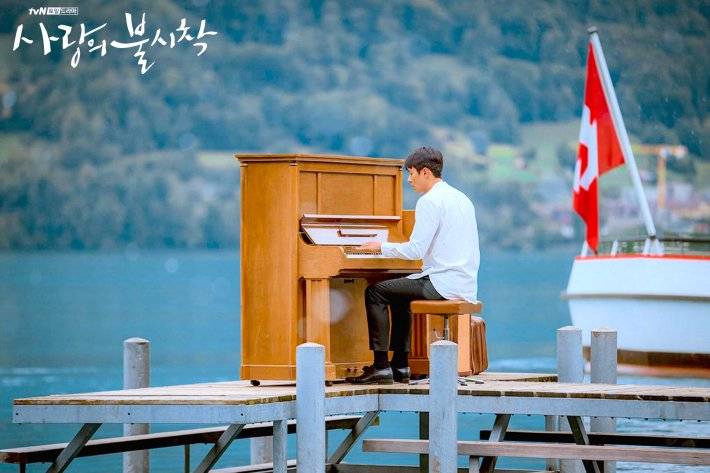
For many visitors, the pier is more than just another tourist attraction. The wooden pier on Lake Brienz became internationally famous after appearing in the Korean drama Crash Landing on You, attracting tourists who want to recreate the iconic scene.
via balmers hostel
Bagotsay said that she and her friends patiently waited for their turn at the popular photo spot.
But when their group finally reached the area, they allegedly began receiving comments from another group of Filipino tourists who were waiting behind them.
Among the remarks reportedly heard in a video were:
“One second lang dapat every picture!”
And, after one of the women reportedly stumbled:
“Sayang, ’di nalaglag!”
The latter comment—essentially expressing disappointment that the woman did not fall—was particularly disturbing to many viewers.
Bagotsay later described how the experience left her and her friends shaken and humiliated. One member of the other group eventually apologized and reportedly explained that the comments were meant as a joke.
But sometimes, calling something a joke doesn’t erase the hurt it caused.
“Joke Lang” Doesn’t Always Make It Okay
This is perhaps one of the biggest lessons from the incident.
There is a tendency among Filipinos to dismiss offensive behavior as “nagjo-joke lang” or “biro lang.”
But humor has a boundary.
If the person you’re supposedly joking with is uncomfortable, frightened, humiliated or crying, then perhaps it stopped being a joke a long time ago.
You don’t get to decide whether someone was hurt simply because you didn’t intend to hurt them.
Intent matters—but so does impact.
And this is especially important when you’re in a public place where everyone is simply trying to enjoy their vacation.
If the group felt that the four women were taking too long, there were countless respectful ways to communicate that.
They could have politely asked if they could go next.
They could have said, “Excuse me, could you please let us know when you’re finished?”
They could have simply waited.
Instead, according to the account shared publicly, the situation escalated into teasing and remarks that left the women feeling bullied.
And that is where basic courtesy should have prevailed.
Being Older Doesn’t Automatically Make Someone Right
Another part of the discussion that stood out was the issue of age.
In Filipino culture, we are taught from childhood to respect our elders.
And that value is important.
But respect should not mean that younger people have to tolerate humiliation simply because the person behaving badly happens to be older.
Respect is not supposed to be a one-way street.
Being older doesn’t give anyone a license to ridicule another person.
Being younger doesn’t mean you have to remain silent when someone crosses a line.
And being a tourist in another country doesn’t give anyone permission to treat fellow Filipinos—or anyone else—as inferior.
As Bagotsay herself emphasized in her account, respect should be mutual.
Why This Incident Hit a Nerve
Perhaps the reason this particular story spread so quickly is because many Filipinos can relate to the feeling of being judged by their own kababayan.
There is a familiar stereotype about Filipinos abroad: that sometimes we can be warm and welcoming toward foreigners while being unnecessarily critical toward fellow Filipinos.
Not every Filipino is like this, of course.
But the stereotype exists for a reason, and incidents like this inevitably bring the conversation back.
Why do we sometimes become more conscious of how we are perceived by foreigners than how we treat our own people?
Why can we be incredibly accommodating to a stranger but impatient with someone who speaks our language?
And why do some people seem to feel that being able to travel abroad gives them a higher social status?
A passport stamp doesn’t make anyone better than anyone else.
Neither does money.
Neither does age.
Neither does the number of countries you’ve visited.
At the end of the day, character is still character.
We Represent More Than Ourselves When We Travel
There is another important aspect to this story.
When Filipinos travel overseas, we inevitably carry a little piece of the Philippines with us.
That doesn’t mean every Filipino tourist has to behave perfectly.
It simply means that our actions can influence how other people perceive our countrymen.
Bagotsay captured this sentiment in her own message, saying:
“Bitbit natin ang pangalan ng bansa natin saan man tayo magpunta.”
We carry the name of our country wherever we go.
That’s why good behavior matters—not because we need to impress foreigners, but because basic decency should be part of being a decent human being regardless of where we are.
If you see another Filipino struggling abroad, help them.
If you see another Filipino taking a photo, give them their moment.
If you think someone is taking too long, ask politely.
And if you disagree with someone, you can communicate without humiliating them.
It really isn’t that difficult.
We Should Be a Safe Place for One Another
Perhaps the saddest part of this story is that the four women were thousands of miles away from home, experiencing what should have been one of the happiest memories of their lives.
Switzerland.
The Alps.
Lake Brienz.
A beautiful location they had dreamed of visiting.
And instead of remembering only the beauty of the place, they now also have to remember being mocked by fellow Filipinos.
That is the part we should think about.
We don’t know everything that happened between the two groups. The public account comes primarily from the women involved, and the other group has not publicly provided its own account, so it is important not to turn an online controversy into a trial where strangers are immediately condemned without knowing the complete circumstances.
But based on what has been publicly reported and shown, there is still a simple lesson that doesn’t require us to know every detail:
Don’t humiliate people for your own amusement.
Don’t make someone else’s vacation miserable because you’re impatient.
Don’t assume that someone deserves disrespect because they’re younger, taking photos, or simply doing something differently from you.
And most importantly, don’t forget that your kababayan is a human being before they are anything else.
Maybe the Real Lesson From Iseltwald Is Simple
The Iseltwald incident has sparked plenty of anger online.
Some people are calling it crab mentality. Others are criticizing the older tourists involved. Some have even used the incident to make sweeping judgments about Filipinos abroad.
But perhaps we should resist that temptation too.
Because saying “Filipinos are like this” simply replaces one form of stereotyping with another.
The better lesson is much simpler:
Some people behave badly. And when they do, we should call out the behavior—not condemn an entire nationality.
We can be proud Filipinos without pretending every Filipino is perfect.
We can defend our kababayan without automatically believing every detail of a viral story.
And we can acknowledge that someone may have been wrong without turning the internet into a mob.
Most importantly, we can choose to be kinder.
Because the truth is, traveling abroad can already be intimidating.
Sometimes, the person who makes you feel safe in a foreign country is another Filipino you happen to meet along the way.
Wouldn’t it be better if that were the experience more often?
Instead of being the kababayan who makes someone cry, be the kababayan who asks:
“Okay ka lang?”
Instead of laughing when someone stumbles, help them up.
Instead of making someone feel small, give them space.
And instead of saying “Biro lang,” perhaps we should learn to say:
“I’m sorry. I didn’t realize I hurt you.”
Because kindness costs nothing.
And wherever we go—whether it’s Switzerland, Japan, the Philippines, or anywhere else in the world—we should never forget that we are all capable of making someone’s day better.
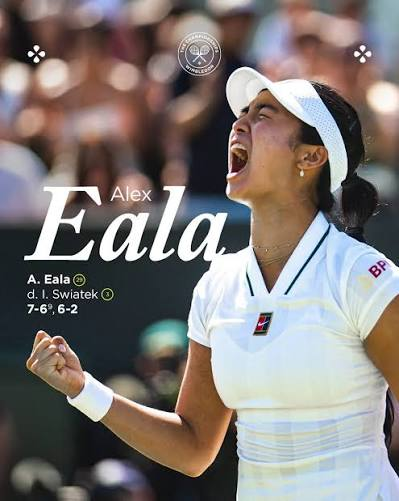
In a stunning display of fearlessness, precision, and pure heart, 21-year-old Alex Eala shattered the Wimbledon draw by dethroning World No. 3 and defending champion Iga Świątek in a straight-sets masterpiece, 7-6 (11-9), 6-2.
For those who watched it live in the middle of the Philippine night, it wasn’t just a tennis match—it was history in motion. Here is what this earth-shaking upset truly means.
What This Means for Philippine Tennis: A New Era
For decades, the Philippines has been a passionate sports nation, but tennis rarely took center stage. Legends like Felicisimo Ampon and Cecil Mamiit paved the way, but a Grand Slam singles breakthrough in the Open Era remained an elusive dream.
With her victory, Eala becomes the first Filipino player in history to reach the Round of 16 at a Grand Slam singles tournament.
This win tears down the invisible barrier for Southeast Asian tennis. It proves that a kid hitting tennis balls in Manila can grow up to look the absolute best in the world in the eye on the sport’s grandest stage and win. It is the ultimate validation for the sport’s infrastructure back home.
What This Means for Alex: The Arrival
Alex Eala has carried the tag of “prodigy” since she won junior Grand Slam doubles and singles titles. But transitioning to the ruthless WTA senior tour is a mountain many junior champions fail to climb.
By taking down Świątek, Eala didn’t just climb the mountain—she planted her flag at the top.
A New Career High: This victory catapults her live ranking to a spectacular World No. 28.
Seeding Validation: Entering the tournament as the No. 29 seed, she proved she doesn’t just belong in the top 30—she can beat the top 3.
The Mental Shift: Beating a multi-time Grand Slam champion on Centre Court changes a player’s DNA. Alex no longer enters tournaments hoping to do well; she enters them knowing she can win them.
The Next Hurdle: Jasmine Paolini
The dream run does not stop to celebrate. On Monday, Eala steps back onto the grass for a high-stakes Round of 16 clash against Italy’s Jasmine Paolini.
While Paolini is a formidable top-15 seed and a former Wimbledon finalist, Eala holds a massive psychological edge: she already beat Paolini earlier this year. Back in February, Eala dominated the Italian 6-1, 7-6 at the Dubai Tennis Championships.
Because Eala blew the bottom half of the bracket wide open by eliminating Świątek, a win against Paolini would give her a highly winnable quarterfinal match against Marta Kostyuk, Daria Snigur, or Ashlyn Krueger. The path to the semifinals is right there for the taking.
The Ultimate Inspiration: Dreaming in Blue, Red, and Yellow
Beyond the ranking points and the prize money, Alex Eala’s dream run is a masterclass in resilience. Her journey hasn’t been a straight line; it has been defined by grueling years on the ITF circuit, tough losses, and quiet rebuilding.
Seeing her fall to her knees on the Wimbledon turf, hands over her face in beautiful disbelief, is the shot of inspiration the Philippines needs. She reminds every young athlete that “impossible” is just a word. As the tournament moves into its second, historic week, an entire nation stands behind her, holding its breath, waiting to see just how far this unstoppable force can go.
The Philippine flags waving around Court 3 weren’t just cheering for a tennis match; they were witnessing history!
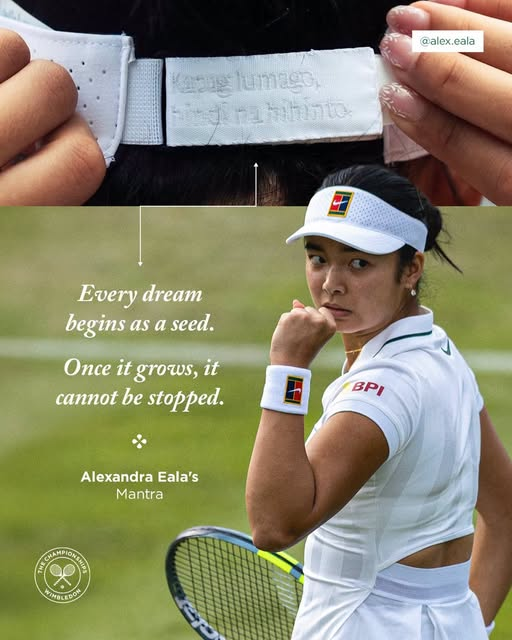
With her emotional 3-6, 6-4, 6-0 comeback victory over Maya Joint, Alex Eala became the first Filipino in the Open Era to reach the third round of a Grand Slam singles main draw. But as the 21-year-old Filipina sensation prepares for the match of her life, all eyes are on the custom phrase embroidered on her visor: “Kapag lumago, hindi na hihinto” (Once it grows, it cannot be stopped).
(Photo via Facebook/Wimbledon)
That mantra is about to face its ultimate trial at the All England Club. Waiting for Eala in Round 3 is none other than the defending champion and world superstar, Iga Swiatek.
Exorcising the Ghosts of Eastbourne
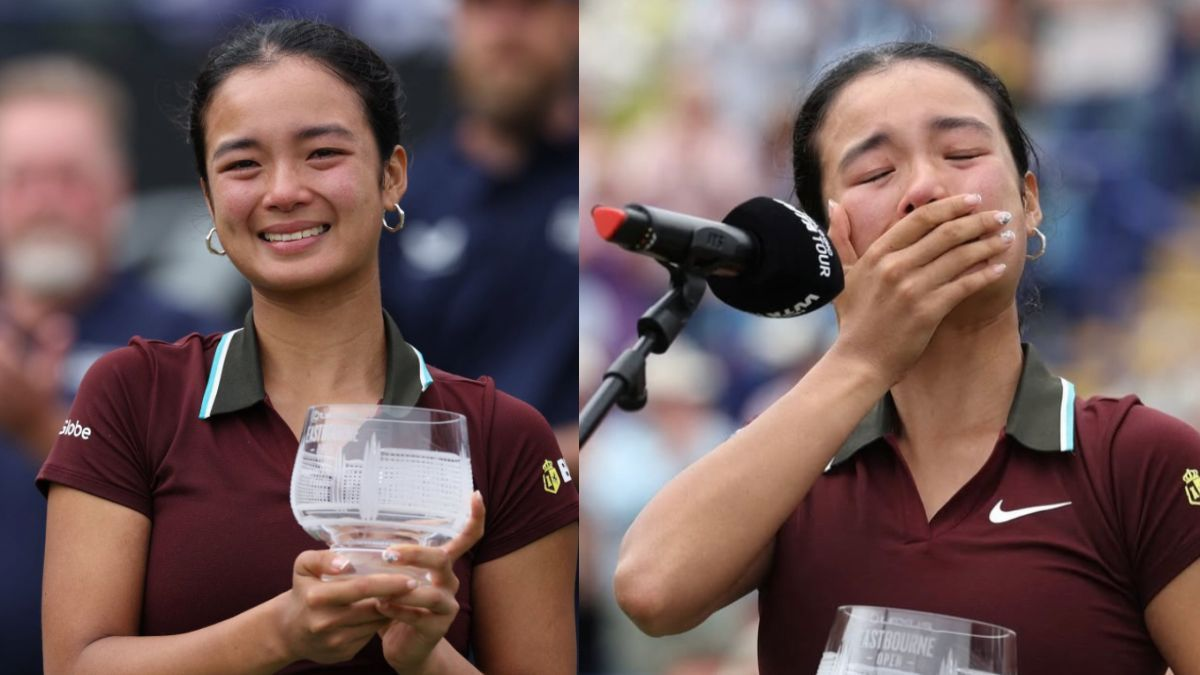
To understand the weight of this moment, you have to look back at where this grass-court swing began. Last year in Eastbourne, Eala sat in a raw, tearful press conference after a painful final loss to Joint. It was a defeat she admitted haunted her for months.
(Photo by Alex Eala on IG)
When Joint took the first set 6-3 on Thursday, it felt like history repeating itself.
Instead, Eala grew.
Showing tactical maturity beyond her years, she weathered Joint’s aggressive plays, and completely flipped the script. By the third set, Eala delivered a ruthless 6-0 bagel against an opponent who had just knocked out Serena Williams. The tears of frustration from Eastbourne transformed into a roar of pure, unadulterated triumph.
The Trilogy Moves to the Grass
Now comes the blockbuster. The tennis world will stop to watch Eala vs. Swiatek Part III.
While the casual sports fan might look at Swiatek’s defending champion status and assume a straightforward match, the history books say otherwise. Eala and Swiatek are deadlocked at 1–1 in their WTA head-to-head records:
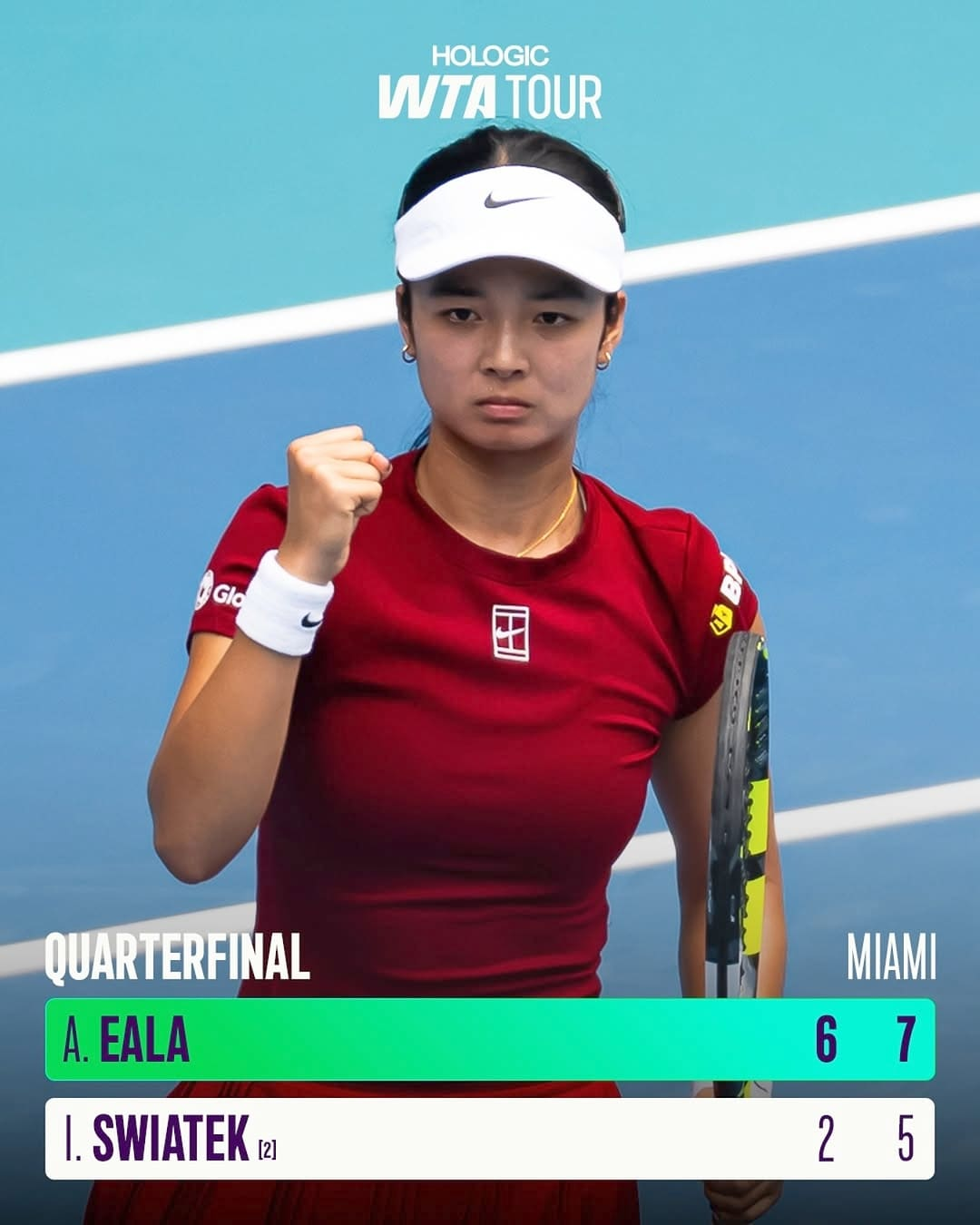
The Shockwave: Eala stunned Swiatek during her breakout run in Miami.
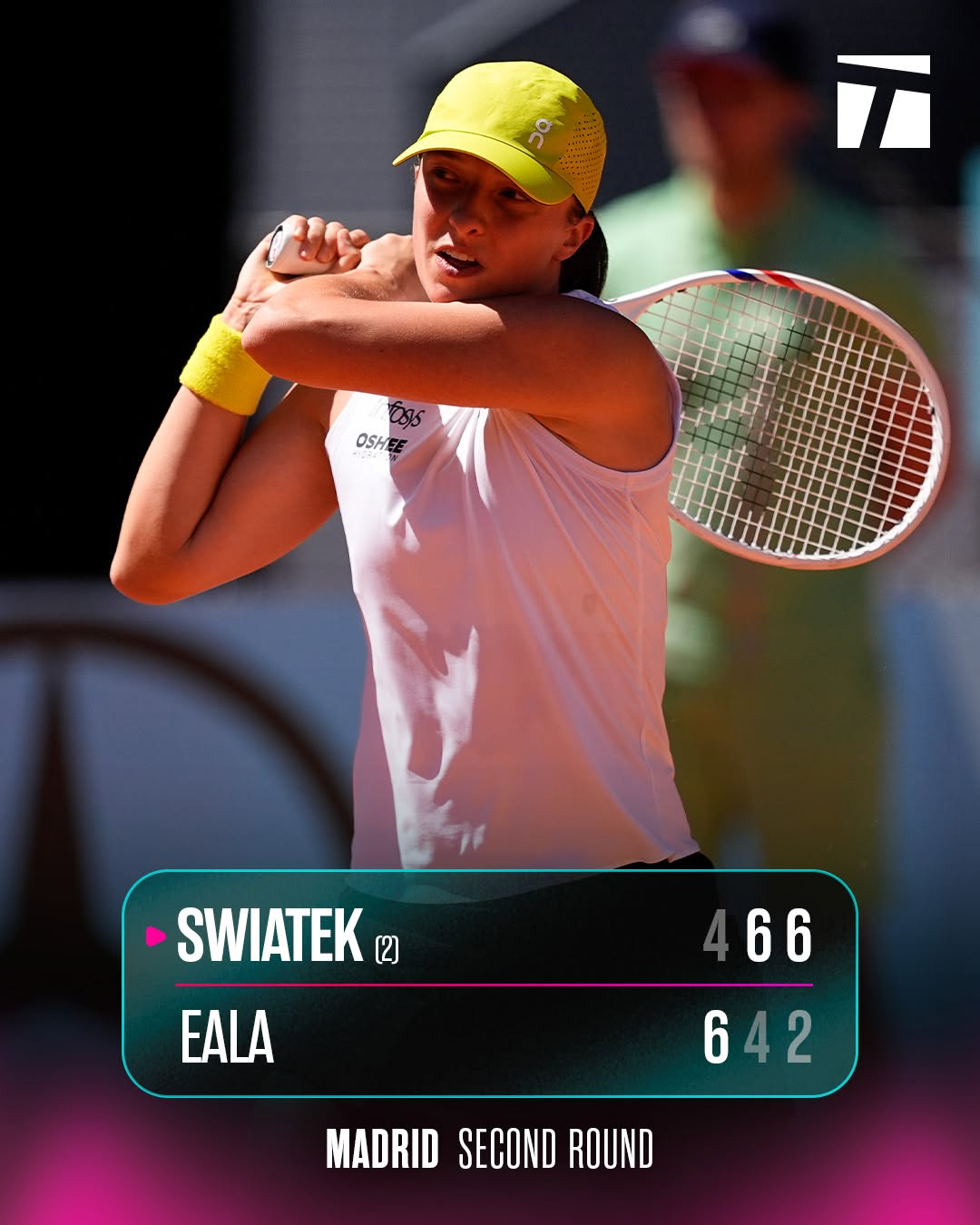
The Revenge: Swiatek answered back with a clinical performance on the clay of Madrid.
(Photo via Facebook/TennisChannel)
But this is their first encounter on grass, a surface that acts as the ultimate equalizer. Swiatek enters the match after a business-as-usual, straight-sets victory over Karolina Pliskova. Eala enters battle-tested, emotionally charged, and riding a wave of national momentum.
Grass demands quick, low-ball adaptations. If Eala can utilize her aggressive left-handed slice to disrupt Swiatek’s rhythmic baseline defense, the defending champion will be forced into uncomfortable territory.
Unstoppable Momentum
Win or lose against Swiatek, Eala has already altered the trajectory of Philippine sports. She has proven that tennis has a permanent, elite home in the tropics.
But looking at the fire in her eyes after the second round, Eala isn’t just happy to be here. The seed of her grass-court game has officially sprouted into a formidable, towering presence on the WTA tour.
And as the visor says: once it grows, it cannot be stopped.
Get to know all 51 Official Candidates competing for the crown in this full introduction video. From pageant veterans and international Filipina representatives to promising new contenders, these inspiring women are ready to shine on the road to Miss Universe Philippines 2026.
Each delegate is featured with her own introduction, highlighting her background, achievements, advocacy, and the province or community she proudly represents. Who do you think has what it takes to become the next Miss Universe Philippines?
✨ Watch the full lineup and comment your early favorites!
A seasoned contender returning to the national stage, Justine previously earned international recognition as 1st Runner-Up at Miss Tourism World 2022. Now a licensed medical aesthetician and wellness advocate, she brings experience, purpose, and the heart of Manila to her journey.
Making history as the first-ever representative of Southern Leyte, Renee brings pride and purpose to the Miss Universe Philippines stage. A Magna Cum Laude graduate of Tourism Management from University of Cebu – Banilad Campus, she now soars globally as an international flight attendant.
With academic excellence, global experience, and a heart for her province, Renee embodies grace, determination, and the spirit of Southern Leyte.
Paddylast Inc. claims no credit for images featured on this site unless otherwise noted. All pictures and media belong to their rightful owners. There is no copyright infringement intended. If you are a copyright holder and wish for credits on your images, please let me know, and I will be glad to add them. If you feel that I have materials on this site infringing your copyright material, don’t hesitate to get in touch with me, and I will remove it immediately.
Please note that this blog is reader-supported. When you buy through links on my site, I may earn an affiliate commission via Amazon Associates Program. As an Amazon Associate, I earn from qualifying purchases.
I also earn a commission, at no additional cost to you if you purchase a product through one of the affiliate links or ads displayed on the website
I contribute content to BeautyPOVPHand help write some of its features. Your support means a lot—please consider liking, commenting, or subscribing to our YouTube channel. It helps us continue bringing you the latest updates in the world of pageantry and beyond.