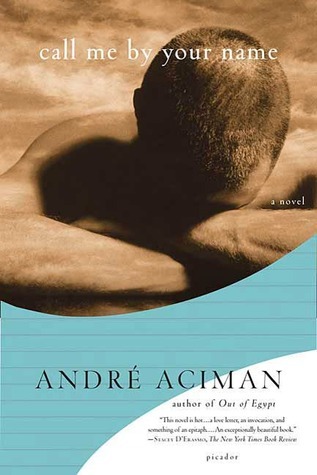
Published: January 23, 2007
Publisher: Farrar, Straus and Giroux
Format: Novel
Genre And Theme: LGBTQ, Romance, Coming-of-Age
Length: 268 pages, ebook
Ebook ISBN/ASIN: B004L62E08
Characters: Elio Perlman,Oliver
Call Me By Your Name is narrated by and tells the story of a seventeen-year-old American-Italian-Jewish youth, Elio Perlman, and his six-week, summer love affair with Oliver, a university professor who is seven years older than Elio and who has been selected to live in Elio’s parents’ home as a guest “resident” while finishing a manuscript for publication as part of the parents’ way of aiding budding writers.
First, let me tell you that this isn’t a five-star read for me. I have conflicting feelings about it. I liked it enough, but then I’d think of one scene I hated, and then I would hate the whole thing, but then Elio would do this, Oliver would do that, Elio would say that, and so on. It’s just giving me a lot of feels – good, bad, depressing, beautiful feelings. I’d say that throughout the book, I became invested enough.
In the first part of the novel, you can sense Elio’s struggle to restrain his desires, his emotions. It was that youthful struggle that I think most of us have experienced in some way or another. At times, it felt like his struggle to conceal his feelings for Oliver bordered on obsession.
“I wanted him gone from our home so as to be done with him. I wanted him dead too, so that if I couldn’t stop thinking about him and worrying about when would be the next time I’d see him, at least his death would put an end to it. I wanted to kill him myself, even, so as to let him know how much his mere existence had come to bother me…”
These struggles became even more complex because he also questioned his identity and the people around him who might question his actions and decisions. Remember, this was set in 1980s Italy – a predominantly Catholic country.
What affected me most is how Aciman brought forth Elio’s emotions as he narrated his times with Oliver. His observations and opinions were so real that it felt like you were Elio at that moment, in that scene.
“It never occurred to me that if one word from him could make me so happy, another could just as easily crush me, that if I didn’t want to be unhappy, I should learn to beware of such small joys as well.”
I also love that Aciman isn’t following a chronological timeline here. It goes back and forth from that one fateful summer up to the present and back again.
“You can always talk to me. I was your age once, my father used to say. The things you feel and think only you have felt, believe me, I’ve lived and suffered through all of them, and more than once—some I’ve never gotten over and others I’m as ignorant about as you are today, yet I know almost every bend, every toll-booth, every chamber in the human heart. – Elio’s Father
Now the second part has more dialogue than the first. It allows you to delve deeper into Elio and Oliver’s interactions. Elio is acting like his younger self – the shy but vibrant boy Elio is the heart of this novel.
“What would happen if I saw him again? Would I bleed again, cry, come in my shorts? And what if I saw him with someone else, ambling as he so often did at night around Le Danzing? What if instead of a woman, it was a man?”
It is here that you can see Elio’s funny side.
“Don’t make it difficult, don’t talk, don’t give me reasons, and don’t act as if you’re any moment going to shout for help. I’m way younger than you and you’d only make a fool of yourself by ringing the house alarm or threatening to tell my mommy. “
“This was not a dessert she was familiar with. But she was going to let me have my way in her kitchen without interfering, as if humoring someone who’d been hurt enough already. The bitch knew. She must have seen the foot. Her eyes followed me every step of the way as if ready to pounce on my knife before I slit my veins with it.”
His internal musings are just funny yet heartbreaking most of the time.
“for you in silence, somewhere in Italy in the mid-eighties.”
I can’t help but think that this book is more like a collection of ruminations on lost love, about someone who has moved forward in life but never truly moved on. That’s a rather hard pill to swallow, isn’t it? It’s as if Elio is in limbo, waiting for his salvation. Alas, the only salvation that occurs here is Elio’s unwavering faithfulness to his heart. There may have been people whom he tried to love, lived with, and even felt passionate about, but there could only be one Oliver for him. It’s a sad reality. It’s unsettling to realize that he hasn’t moved on. It’s infuriating to think that this selfish American man, who captured the heart of a seventeen-year-old Italian boy, has never reciprocated such a deep connection or devotion. At least, that’s the impression I got from Oliver’s character. There doesn’t seem to be enough regret from him. Oliver simply moved on from that summer; it’s just a memory for him. And that’s what frustrated me the most about this book. Oliver’s character comes across as one selfish individual who doesn’t deserve Elio’s lifetime of adoration. Well, that’s just my perspective, though.
Overall, the writing, for me, was almost reminiscent of Alire-Saenz’s style. However, Aciman perhaps went overboard, resulting in mostly pretentious dialogues. I rolled my eyes several times but hoped that the ending would at least be hopeful, or if not hopeful, for someone other than Oliver. Alas, it’s a disaster. I don’t blame the author for this; I just regret investing so much time caring for Elio. And no, I’m not calling Oliver by his name.
I am hoping that I’d like the movie more.
Rating: 3.5 out of 5 stars
About The Author
André Aciman was born in Alexandria, Egypt and is an American memoirist, essayist, novelist, and scholar of seventeenth-century literature. He has also written many essays and reviews on Marcel Proust. His work has appeared in The New Yorker, The New York Review of Books, The New York Times, The Paris Review, The New Republic, Condé Nast Traveler as well as in many volumes of The Best American Essays. Aciman received his Ph.D. in Comparative Literature from Harvard University, has taught at Princeton and Bard and is Distinguished Professor of Comparative Literature at The CUNY Graduate Center. He is currently chair of the Ph. D. Program in Comparative Literature and founder and director of The Writers’ Institute at the Graduate Center.
Aciman is the author of the Whiting Award-winning memoir Out of Egypt (1995), an account of his childhood as a Jew growing up in post-colonial Egypt. Aciman has published two other books: False Papers: Essays in Exile and Memory (2001), and a novel Call Me By Your Name (2007), which was chosen as a New York Times Notable Book of the Year and won the Lambda Literary Award for Men’s Fiction (2008). His forthcoming novel Eight White Nights (FSG) will be published on February 14, 2010



 PADDYLAST INC.
After all, what the book fascinates me is that it has something to do with boys love affair. 🙂 I will first watch the movie before I give it a try, so that I would not be disappointed. 🙂
I’ve high hopes that the film won’t disappoint given that it’s racking up award noms everywhere and based on some snippets on YouTube – I’d say it’s heaps better than the source. We’ll see…
Well, there are three possible consequences:
a. The novel turns out to be more interesting than the movie.
b. The movie turns out to be more absorbing than the novel.
c. And, if both the movie and novel turn out to be suckers, the novel implies that it is not a good read, but I still recommend it since there are many kinds of beholders in the universe. All books have souls as what Virginia Woolf put it mildy. Hahaha 🙂
Hahaha! Absolutely! ^_^ The wait is killing me. LOL